Many thanks to Ray Laurence, Karla Pollmann and Dunstan Lowe from the School of European Culture and Languages, Department of Classical & Archaeological Studies at the University of Kent for their help and advice in providing a translation for 'The Forgotten Frontline' - 'Limes oblitus'.
Tuesday, August 27, 2013

Custard Cream Castle - Could we do something like this in Kent...??
Could we do something like this in Kent..??
Carlisle Castle has been recreated in cake form by a team of volunteers armed with thousands of custard creams.
Staff from three local baking firms used 5,000 of the biscuits to help create the structure as part of the city's summer pageant celebrations.
It took the group three days to complete the castle, which measures about 1.2m (4ft) square. Visitors were able to sample a piece of the creation during the pageant.
Volunteers came forward after a Facebook appeal from English Heritage, which runs the castle.
Carlisle Castle has been recreated in cake form by a team of volunteers armed with thousands of custard creams.
Staff from three local baking firms used 5,000 of the biscuits to help create the structure as part of the city's summer pageant celebrations.
It took the group three days to complete the castle, which measures about 1.2m (4ft) square. Visitors were able to sample a piece of the creation during the pageant.
Volunteers came forward after a Facebook appeal from English Heritage, which runs the castle.

Let us know if you have any suggestions.
Monday, August 26, 2013
Boy Scouts - The the greatest moral force that the World had ever known?
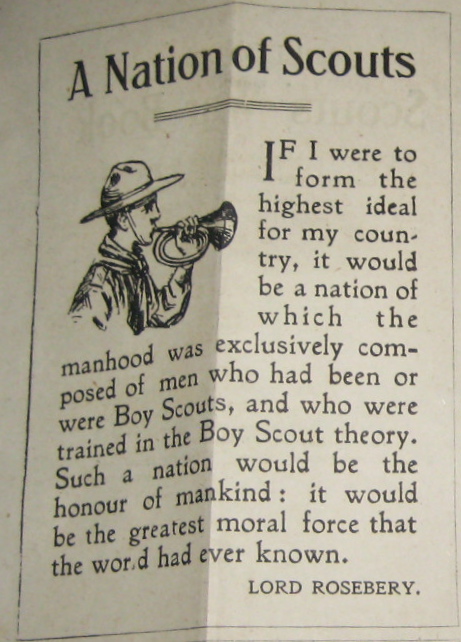
In 1912, former British Prime Minister Lord Rosebery provided some memorable observations, made in the course of an address he gave to the Boy Scouts of Midlothian:
It would be the greatest moral force that the World had ever known."
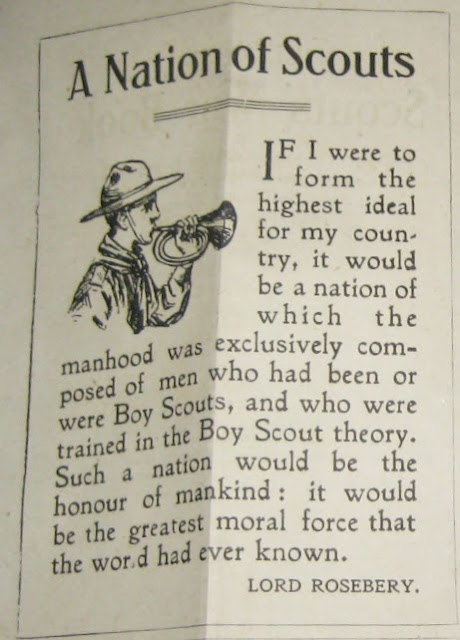
"If I were to form the highest ideal for my country, it would be a nation of which the manhood was exclusively composed of men who had been, or were, Boy Scouts, and were trained in the Boy Scout theory...
Such a nation would be the honour of Mankind...
Scout's War Book - Lloyd's Weekly News 1914
Published by Lloyd's Weekly News in 1914 - the "Scouts War Book" provided advice and guidance on a range of tasks and activities for Boy Scouts involved,or hoping to become involved, in the war effort, including:

What to do in air raids
First Aid
Facts about Army Navy flying
Wolf Cubs
How to become a Scout
From the Guardian's Archive "The Scout's part in the War"- December 1914
Originally published in the Manchester Guardian in December 1914, this short article highlights the role of the Boy Scouts during the First World War entitled- "The Scout's part in the War"
Most of us know, for the press was generous, what he
did at the outbreak of the war – how he helped the police and
Territorials in guarding bridges and culverts, telegraph and railway
lines, often keeping night watch, and running what might have proved
serious risks; how on foot and cycle he delivered countless messages,
and reported several not imaginary spies; and how he enjoyed it all,
feeling that at last he was playing the real game, as a recognised
servant of the King.
For the Scouts, too, in all countries, were mobilised, and I imagine that in varying ways they have equally proved their value everywhere.
In Belgium they have seen much active service.
In France many have made their way to the front, and serve as despatch riders – one such, after being wounded in Alsace, near Rheims, and at Ypres, is in Manchester, and many more have been organised for ambulance work and for replacing minor cogs in the administrative wheel.
A.H.H
The time perhaps has come when we may usefully consider to what
extent the Boy Scout movement has justified its existence as a helpful
agency in time of war. Only a few years back we were most of us smiling
at the mimic warfare of the bare-kneed youngster with the broomstick.
Now that the country is up against the real thing, and even a boy
counts, what do we find that this same small warrior has learnt to do?
What real service does he render that has won his picturesque and
healthy uniform official recognition? In what way has he, adding his
little contribution to the common store, deserved well of his
Fatherland?
For the Scouts, too, in all countries, were mobilised, and I imagine that in varying ways they have equally proved their value everywhere.
In Belgium they have seen much active service.
In France many have made their way to the front, and serve as despatch riders – one such, after being wounded in Alsace, near Rheims, and at Ypres, is in Manchester, and many more have been organised for ambulance work and for replacing minor cogs in the administrative wheel.
Personally, I shall not easily forget the sight of French Scouts
piloting our own soldiers round at Havre in August acting as guides,
interpreters, and very faithful squires. "Please tell Baden-Powell that I
don't know how we should get on without these little chaps," was the
repeated request of officer and private alike.
In England some
fourteen hundred Scouts have, since the war began, been patrolling the
coasts keeping watch, signalling ships, and generally replacing
coastguards now on active service.
A motor ambulance manned by expert
Scouts is being sent to France.
Over ten thousand ex-Scouts are known to
be with the colours, and officers have abundantly recognised the value
of their training and their spirit.
The Boy Scouts have offered to raise
for service at the front a full battalion of cyclists, provided with
machines and a guaranteed proficiency in scouting and despatch-riding.
A.H.H
FFL Blogger - Social Network Update
We have now added Google + and Linkedin to The FFL Blogspot profile.
Saturday, August 24, 2013
Subscribe to:
Posts (Atom)